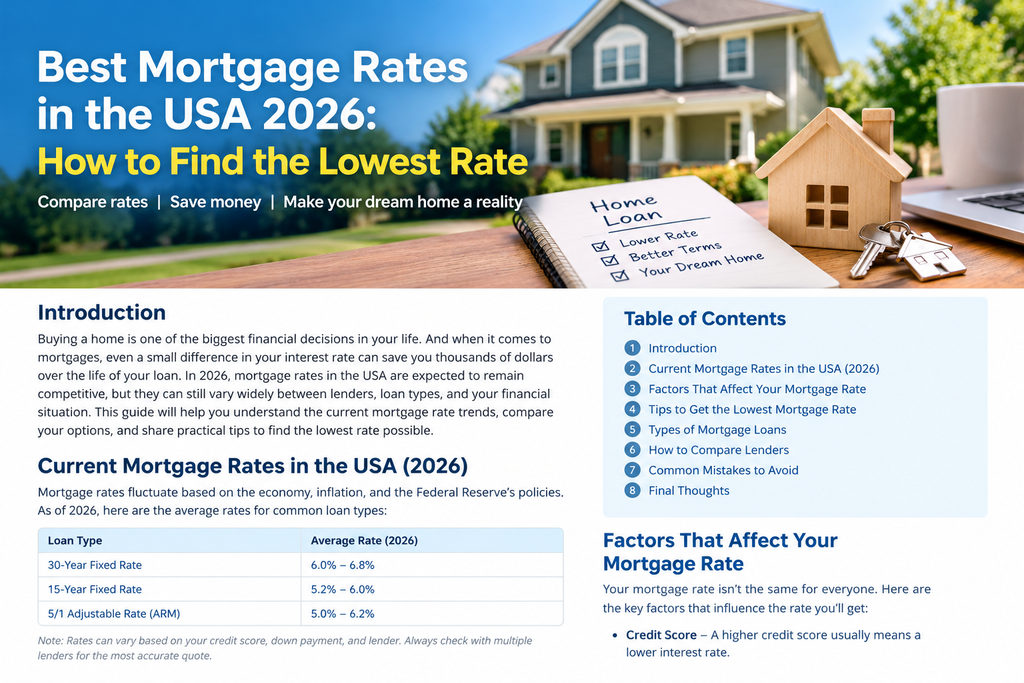
Best Mortgage Rates in the USA 2026: How to Find the Lowest Rate
Buying a home is one of the biggest financial decisions most Americans make. For many buyers, the mortgage interest rate can have a major impact on the total cost of homeownership.
In 2026, borrowers have many mortgage options, including fixed-rate mortgages, adjustable-rate mortgages, FHA loans, VA loans, and conventional home loans. However, the rate offered to one borrower may be different from the rate offered to another.
The good news is that you don’t have to accept the first mortgage offer you receive. Comparing lenders, improving your credit profile, choosing the right loan term, and understanding fees can help you make a more informed decision.
What Is a Mortgage Rate?
A mortgage rate is the interest rate a lender charges for borrowing money to purchase a home.
For example, if you borrow $300,000, the interest rate affects how much interest you pay over the life of the mortgage. Even a small difference in the rate can change your monthly payment and total interest cost.
Your actual rate can depend on factors such as:
- Credit score
- Down payment
- Loan amount
- Loan term
- Debt-to-income ratio
- Property type
- Loan type
- Market conditions
Mortgage Rates in the USA in 2026
Mortgage rates change regularly. They can move because of economic conditions, inflation expectations, bond-market activity, lender pricing, and other factors.
Rather than focusing only on a single advertised rate, homebuyers should compare the complete cost of each mortgage offer.
When comparing offers, look at:
- Interest rate
- Annual percentage rate (APR)
- Origination fees
- Discount points
- Closing costs
- Monthly payment
- Prepayment terms
- Fixed or adjustable rate structure
An advertised rate may not be available to every borrower, so getting a personalized quote is important.
Why Your Credit Score Matters
Your credit history can have a significant effect on your mortgage options.
Generally, borrowers with stronger credit profiles may qualify for more competitive rates. Before applying for a mortgage, review your credit reports and look for errors that may need to be corrected.
You can also work on reducing outstanding debts and maintaining a consistent payment history.
A better credit profile doesn’t guarantee a specific mortgage rate, but it can improve your chances of qualifying for favorable loan terms.
How Much Should You Put Down?
A down payment is the amount you pay toward the home upfront.
A larger down payment can reduce the amount you need to borrow. Depending on the loan program, it may also affect mortgage insurance requirements and overall borrowing costs.
However, putting more money down isn’t automatically the right choice for everyone. Homebuyers should consider keeping enough cash available for:
- Emergency expenses
- Moving costs
- Home repairs
- Closing costs
- Furniture and other expenses
The right down payment depends on your overall financial situation.
Fixed-Rate vs. Adjustable-Rate Mortgages
One of the most important decisions is choosing between a fixed-rate mortgage and an adjustable-rate mortgage (ARM).
Fixed-Rate Mortgage
A fixed-rate mortgage keeps the interest rate unchanged for the agreed loan term, assuming the loan remains in place.
This can make monthly principal-and-interest payments easier to plan.
Common terms include:
- 30-year fixed
- 20-year fixed
- 15-year fixed
Adjustable-Rate Mortgage
An ARM typically starts with a fixed interest rate for a specific period. After that period, the rate can adjust according to the loan’s terms and the applicable index.
An ARM may offer a lower initial rate than some fixed-rate options, but borrowers need to understand how and when the rate can change.
Always review the adjustment rules, caps, and maximum possible rate before choosing an ARM.
Conventional vs. Government-Backed Loans
Homebuyers can choose from different mortgage programs.
Conventional Loans
Conventional mortgages are not insured or guaranteed by the federal government. They are commonly offered by banks, credit unions, mortgage companies, and other lenders.
Requirements vary by lender and borrower profile.
FHA Loans
FHA-insured mortgages are designed to provide an option for eligible borrowers who may not meet conventional lending requirements.
They can have different down-payment and mortgage-insurance requirements, so buyers should compare the total cost.
VA Loans
Eligible veterans, active-duty service members, and certain surviving spouses may qualify for VA-backed home financing.
VA loans can have specific eligibility requirements and features that differ from conventional mortgages.
USDA Loans
USDA-backed mortgages are available to eligible borrowers purchasing qualifying properties in eligible rural areas.
Income and property requirements apply.
How to Find the Lowest Mortgage Rate
Finding a competitive mortgage rate requires more than searching for one number online.
1. Compare Multiple Lenders
Request quotes from several lenders. You can compare banks, credit unions, mortgage companies, and other qualified lenders.
Getting multiple quotes can help you understand the range of offers available to you.
2. Compare APR, Not Just the Rate
The interest rate is important, but APR can provide additional information about the overall cost of borrowing because it incorporates certain fees and charges.
When comparing lenders, review both the advertised rate and APR.
3. Ask About Discount Points
Mortgage points are upfront fees that can sometimes be used to reduce the interest rate.
Before paying points, calculate how long it would take for the monthly savings to recover the upfront cost.
4. Improve Your Credit Before Applying
If you have time before purchasing, review your credit profile and address outstanding issues.
Avoid taking on unnecessary new debt immediately before applying for a mortgage.
5. Consider Different Loan Terms
A 15-year mortgage may have a different rate and payment structure than a 30-year mortgage.
A shorter loan term can mean higher monthly payments but may reduce total interest paid over the life of the loan.
6. Negotiate Where Possible
Some mortgage costs may be negotiable depending on the lender and circumstances.
Ask lenders for a complete breakdown of rates, fees, credits, and closing costs.
What Is a Mortgage Rate Lock?
A mortgage rate lock allows a borrower to lock in an interest rate for a specified period while the loan moves through the closing process.
Rate-lock policies vary between lenders.
Before accepting a lock, ask:
- How long does the lock last?
- Is there a fee?
- What happens if closing is delayed?
- Is a float-down option available?
- What happens if rates fall after locking?
Understanding these details can help avoid surprises.
Common Mortgage Mistakes to Avoid
Choosing the First Offer
The first mortgage offer you receive may not be the only option available. Comparing several offers can provide a clearer picture of your choices.
Focusing Only on the Monthly Payment
A lower monthly payment does not necessarily mean a cheaper mortgage. Look at the interest rate, loan term, fees, and total borrowing costs.
Ignoring Closing Costs
Closing costs can add thousands of dollars to the amount needed at closing. Ask for a detailed estimate before making a final decision.
Taking on New Debt
Taking out a new loan or making large purchases before closing can affect your debt-to-income ratio and potentially complicate the mortgage process.
Not Reading the Loan Terms
Always review the loan documents carefully. Make sure you understand the rate, payment, fees, penalties, insurance requirements, and other conditions.
Frequently Asked Questions
What is a good mortgage rate in 2026?
There is no single mortgage rate that is considered good for every borrower. Rates vary according to loan type, credit profile, down payment, lender, location, and market conditions.
How can I get a lower mortgage rate?
Comparing multiple lenders, maintaining strong credit, considering different loan terms, and reviewing points and fees can help you look for a competitive offer.
Should I choose a 15-year or 30-year mortgage?
A 15-year mortgage can reduce the repayment period but generally comes with higher monthly payments. A 30-year mortgage usually provides lower monthly payments but spreads repayment over a longer period.
Is the lowest interest rate always the best mortgage?
Not necessarily. A loan with a lower advertised rate may have higher fees or other costs. Compare the APR and complete loan estimate rather than looking at the interest rate alone.
Final Thoughts
Finding the right mortgage in 2026 requires careful comparison. Instead of choosing a loan based only on an advertised interest rate, look at the complete cost, including APR, fees, closing costs, loan term, and payment structure.
Before committing to a mortgage, compare multiple lenders and request personalized loan estimates. Taking time to understand your options can help you make a more informed home-financing decision.
This article is for general educational purposes and is not financial advice. Mortgage rates, eligibility requirements, fees, and loan terms vary by lender and borrower. Always review current offers and official loan documents before making a financial decision.